Join/Renew





A significant challenge persists in higher education: bridging the academic-career gap, as many graduates continue to struggle with articulating how their academic experiences translate into workplace competencies. Employers are clearly looking for applicants with appeal beyond grades; they want someone who will fit the organization’s culture and has a broad range of (career readiness) skills that are difficult to assess through a transcript.
A critical task for students, then, is making connections between their academic experience and their professional goals, especially when communicating their career readiness to potential employers.1 Without an effective personal narrative, students are limited in their ability to communicate to a professional audience their preparedness for assuming the responsibilities of the position they desire to obtain.2
An ePortfolio provides a highly successful approach to creating a professional presence, complementing the transcript and resume as a “tool to enhance the employability, career development, and professional identity of graduates.”3 A well-crafted ePortfolio can help students fashion a professional identity and combine their academic, co-curricular, and extracurricular experiences so that an employer can more easily appraise their knowledge and skills.
The role that ePortfolios can hold—including evidencing students’ personal, academic, and professional development; addressing broad theory-to-practice experiences; and supporting reflective practices—indicates that they are well-suited for supporting the development and communication of competencies identified by the National Association of Colleges and Employers (NACE). The tension that exists between practicing these professional skills and evidencing them to improve employability is a gap that can be filled by integrating ePortfolios into the curriculum.4
The benefits persist whether or not the potential employer reads the student ePortfolio. The exercise of creating it is valuable for employment preparation, including interviewing, because, as Cordie et al noted, having created a narrative to organize their ePortfolio, candidates are better prepared to address common interview questions, such as “Tell me about yourself?”5 Moreover, the metacognitive learning that occurs as students reflect on and articulate their achievements helps them connect academic experiences with employer-valued skills, such as communication, critical thinking, teamwork, and self-awareness—competencies increasingly important in an AI-influenced job market where technical skills alone are not enough.
The author examined the effectiveness of ePortfolios as a high-impact pedagogical tool for achieving four primary objectives:
- Fostering reflective practice;
- Facilitating self-assessment of professional development;
- Enhancing awareness of essential career readiness skills as defined by NACE; and
- Promoting visible learning through evidence-based artifact displays that demonstrate attainment of course learning objectives and corresponding NACE career competencies.
The study hypothesized that integrating the NACE career readiness framework with ePortfolio pedagogy would provide students with explicit connections to course learning outcomes, thereby enhancing students' metacognitive awareness and facilitating knowledge transfer and articulation across academic and professional contexts. Further, incorporating structured reflection and meaning-making activities focused on these core competencies would enhance students' ability to conceptualize, value, and communicate their learning; establish connections to experiential knowledge; and inform future academic and career planning.
The 6-I ePortfolio Model
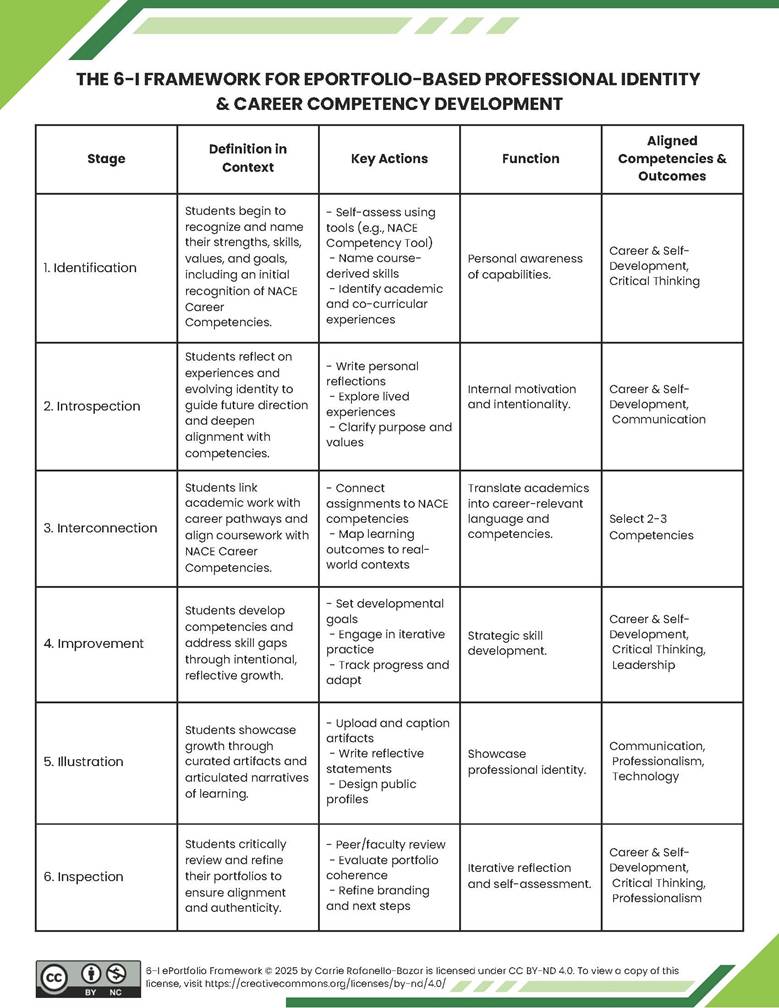
The author created the 6-I Framework, a student-centered model, to guide the study’s ePortfolio-NACE competency integration and implementation process across the biology program. The framework, developmental in approach, is based on a reflective-active cyclical process where students revisit the six stages as they progress through their academic and career journey, adding new experiences, incorporating feedback, and reflecting on the competencies developed through their academic, personal, and professional development. The ePortfolio is used for digital storytelling, reflection, and learning artifact creation to support students in their professional identity construction, development, articulation, and self-assessment of NACE competencies, and the creation of a professional branding tool.
The author applied this framework to analyze student meaning-making by examining written reflections and created artifacts that demonstrate connections to the NACE competencies. The framework is a meaning-first model purporting that students recognize what they know, then connect those insights to NACE competencies, course outcomes, and/or career contexts. Students self-examine and connect what they’re learning to who they are and who they want to become, before they align that learning to the NACE competency framework. As students build meaning from these connections, they can use that awareness and relevance to drive intentional competency development as they advance in their program of study.
By integrating the NACE career readiness framework with ePortfolio development, the author’s 6-I Framework empowers students and nurtures progression through six stages (identification, introspection, interconnection, improvement, illustration, and inspection) that support students in recognizing, demonstrating, articulating, and showcasing the value of their degree and the associated career readiness competencies essential for a successful career launch.
Approach/Research Design
A mixed methods approach was used, combining a quantitative survey with qualitative, narrative analysis of ePortfolio content, focus group transcript, and a semi-structured faculty interview. This article focuses on the qualitative data collected in the broader study (that used survey findings with quantitative results).
Inductive coding and thematic analysis were conducted to examine narrative elements, including student ePortfolios, the focus group, and interviews. Inductive coding allowed themes related to how students “make meaning” to emerge naturally; this study is intended to be exploratory and anticipated uncovering themes that aren’t that prevalent in existing research.
This study used a course-based strategy (within the biology program of study) over the academic year that was piloted in a single section of the new Foundations of Science course, offered for the first time in fall 2024; two sections of General Biology 1 (BIOL101), four sections of General Biology 2 (BIOL102, including an honors section), and the single sections of 200-level program elective courses, Cellular & Molecular Biology, and Genetics, respectively.
Applying the 6-I Framework to Implementation
The author’s 6-I framework for implementation scaffolded the ePortfolio learning and reflection process across courses spanning a program. Students were introduced to reflective writing and contemplation of professional identity, academic and career plans and goals in Foundations of Science Success, a course aimed at promoting college success (by early development of the skills and attitudes needed to achieve educational, personal, and career goals in the field of science).
As students progressed through the biology program, they intentionally reflected on the alignment of individual course learning objectives with NACE career readiness competencies and broader program learning outcomes. The perspective for upper-level program courses shifted to facilitating meaning-making over time and shaping students’ formation of a more cohesive career narrative, along with consideration of their anticipated transfer and career preparation process.
The author structured the implementation framework by first initiating a program mapping process to align the participating courses and their “signature learning assignments” with course learning outcomes, broader program learning outcomes, and the associated NACE career competencies.6 Instead of attempting to include all eight career competencies, the author focused on those that were most aligned with the course.
Students used an ePortfolio to explicitly connect their authentic learning artifacts to future career applications through structured reflections involving competency mapping. Project prompts required students to identify the career competencies demonstrated through their learning projects. These prompts also asked students to reflect on “how their awareness of competencies changed over the semester.” Additionally, students were asked to articulate “how the knowledge and skills gained might be useful in your future.”
Reflective prompts at the mid-point and conclusion of courses also pushed students to articulate their strengths, weaknesses, and evolving professional identities.
Data Collection Process
For each course in this study, the author provided in-class training on the ePortfolio platform, delivered presentations on its value for learning and professional development, shared an exemplar of student work, facilitated the identification of specific core career competencies embedded within course learning objectives, and guided students through the setup and navigation processes.
Sampling Process:
Total Sample size: n=140
Both quantitative and qualitative survey data were collected during the research study.
Data Sources
- Student ePortfolios: including reflective writing, artifact descriptions, and competency-based short narratives.
- Student focus group and semi-structured interview with faculty to deepen insight into perceptions and processes.
- Likert-scale digital survey including six open-ended and 11 closed questions.
Data Sources
- 104 students participated in the survey: 580 open-ended survey responses and 935 closed-response questions were analyzed.
- Student reflections were reviewed for each dataset.
- Focus group with five student participants.
- Semi-structured interview with three full-time faculty members.
Data Analysis + Findings
The qualitative data collected was analyzed and summarized with AI-supported technology, including Open AI Claude.AI and Open AI ChatGPT.7,8 Thematic content analysis with inductive coding was conducted to identify emerging themes while preserving authentic student voices. Several recurring and significant themes emerged from the data that reveal the connections between students' use of ePortfolios, their construction of professional identity, and growth in career readiness.
Across ePortfolio reflections, most students indicated growth in the NACE competencies. A trinity of core skill development in the areas of communication, teamwork, and critical thinking was identified by students in the core biology courses, which had been purposefully mapped to the course learning objectives. Nearly every student referenced enhanced ability to analyze and interpret data, especially when results were unexpected or complex. Students also recognized teamwork skills (from their group work) as directly applicable to professional environments where they imagined navigating diverse teams, dynamics, and communication styles.
Reflective prompts pushed learners to articulate strengths, weaknesses, and evolving professional identities. Students demonstrated their blossoming self-awareness and capacity for professional development as signified by their direct quotes. Gains in career and self-development showed enhanced ability to identify their own strengths and growth areas and formulate plans for continuing improvement.
Supporting evidence also revealed students’ ability to connect project experiences and skills to their future academic and career goals. Through their use of ePortfolios, they indicated clear linking of coursework to specific career aspirations and professional scenarios. These reflections not only demonstrated how the course project enhanced academic skills but also how it contributed to professional identity formation, greater confidence, and understanding of application toward future careers. Students demonstrated awareness of how discipline content and skills developed in the project would transfer to future academic and professional contexts, even clarifying how competencies supported professional goals and paths like healthcare, environmental science, and lab-based careers.
Professional identity formation was evident, as students began to see themselves as science professionals through the creation of a professional online presence, their progression of disciplinary expertise, practice in professional communication, and building confidence in sharing their work publicly. In addition to self-assessment, students described the value of ePortfolios as a public, enduring archive they could share with employers, transfer schools, or future instructors, illustrating its value in future orientation and application.
Collectively, the thematic analysis revealed that students experienced significant professional and personal development through their ePortfolio learning process. The ePortfolio served as a powerful mechanism for professional identity construction and career readiness. Moreover, the metacognitive awareness displayed by students suggests the ePortfolio process fostered deep reflection and professional identity development. Students moved from passive recipients of content to active constructors of professional identity, explicitly connecting their academic experiences to future career contexts. Additionally, the process of documenting and reflecting on achievements through ePortfolios appeared to strengthen students' professional self-concept and confidence in their future career prospects. They began to see themselves as aspiring professionals.
Students used their ePortfolio to tell the story of their academic journey and articulate their developing identities as professionals in STEM fields. They shared personal learning experiences and contextualized their academic work within broader personal and career goals, which were facilitated through structured reflection prompts. Students were tasked with identifying competencies developed through their projects and articulating connections between their academic work and future career applications.
The use of ePortfolios provided a vehicle for students to recognize the career competencies they were developing, hence contributing toward their academic and professional identity formation and increasing their awareness of and confidence in career readiness. Students demonstrated the ability to identify their own growth areas, evidencing self-directed learning. Several students shared personal insights about their learning processes and evolving skills, and student statements reflected an increasing awareness and internalization of NACE competencies.
In addition, anecdotal feedback from a focus group with three participating full-time faculty members revealed important considerations for future implementation with faculty partners. An important observation expressed by faculty when it comes to ePortfolios is developmental readiness, which aligns with the author’s 6-I implementation framework, emphasizing the importance of scaffolding the ePortfolio teaching and learning process. Foundational students need to practice reflective writing, while upper-level students produce more substantive work.
Faculty highlighted the instructional value of using ePortfolios as an intentional pedagogical tool to structure reflection, align assignments to competencies, and facilitate students’ ownership of learning. The faculty explained that the ePortfolios helped students recognize and articulate the skills they’re developing through coursework. A faculty member described how the tool facilitates conversations about how their learning translates into their careers.
The faculty members also remarked on the intentional career competency integration with course assessments, which helped students begin to see the relevance of academic tasks in preparing for their future roles. Finally, evidence certified that ePortfolios provide insight into student development across course levels, enabling faculty to see student recognition of challenges and growth areas and facilitate assessment of both content knowledge and metacognitive skills.
Implications for Practice
Findings from this study suggest several evidence-based recommendations for career development practitioners and faculty implementing competency-based ePortfolio pedagogy. These recommendations synthesize best practices, the 6-I framework, and empirical findings from this investigation:
Scaffolded Program Implementation
- Introduce ePortfolios early in academic programs (foundational courses or first-year seminars) and early within individual courses to establish reflective practices from the start.
- Build and submit ePortfolios in stages throughout the semester to ensure deeper learning, ownership, and timely formative feedback rather than single end-of-term submissions.
- Create mini-assignments and low-stakes experiences that build career competency awareness gradually, with reflection and self-assessment attached and instructor feedback provided throughout the process.
Explicit Competency Integration
- Identify courses using signature assignments and active learning strategies (experiential learning, service learning, research, project-based learning, capstones) as ideal integration points.
- Provide templates that map project outcomes directly to specific NACE competencies to strengthen self-assessment and employer readability.
- Use transparent rubrics with clear criteria and explicit instructions that assess both ePortfolio reflections and identified competencies for learning assignments.
Structured Reflection and Iteration
- Provide clear, scaffolded prompts that support critical thinking and reflective practice within ePortfolios, progressing from descriptive to analytical to future-oriented.
- Support multiple submissions and updates to demonstrate ongoing development and iterative refinement.
- Connect ePortfolio work explicitly to professional applications through examples, alumni testimonials, and employer perspectives.
Support Infrastructure and Community
- Ensure effective platform selection with adequate technical support and training throughout implementation.
- Create additional touchpoints beyond individual courses (advising offices, career services, student life) to establish a robust support system.
- Provide continued technical and conceptual support for ePortfolio maintenance beyond course completion.
Professional Context and External Engagement
- Invite alumni and employer partners to inform students about the educational and professional value of ePortfolios and their distinction from platforms like LinkedIn.
- Open ePortfolio presentations to external audiences through capstone experiences, campus gallery walks, or professional showcase events.
- Create opportunities for peer and faculty engagement through collaborative communities, structured peer reviews, and feedback sessions.
Enhanced Assessment and Recognition
- Establish clear assessment rubrics valuing both artifacts and reflective analysis.
- Enhance student engagement through social learning components, using ePortfolios as community spaces for collaborative projects and structured peer reviews.
- Consider creating a "Badges" section where students attach verifiable digital badges from curricular or co-curricular activities as visible evidence of competency achievement,
Strategic, coordinated program-wide implementation with dedicated support structures appears more effective than isolated course initiatives for maximizing ePortfolio impact on professional identity development and career readiness.
Conclusions
As anticipated, this investigation demonstrated that ePortfolios facilitate the contextualization of learning experiences through narrative construction, promote reflective learning practices, enable the identification and articulation of NACE career competencies, and provide a repository for documenting and preserving significant developmental milestones.
The findings indicate that ePortfolios enhance both academic advancement and career preparation by providing structured opportunities for self-reflection and creating connections between curricular content and professional practice. Through the development of ePortfolios across multiple course experiences, participants engaged in professional identity formation while documenting their evolving competencies, knowledge acquisition, and career trajectory development.
Having a centralized space to document and link learning experiences promoted deeper reflection, intentional future planning, and served as a catalyst for comprehensive personal and professional development.
The integration of ePortfolios with NACE competency framework components facilitated an active learning approach wherein participants engaged in self-assessment and reflection regarding their existing capabilities, established developmental objectives, and identified strategies for competency enhancement.
ePortfolios impacted students through its explicit focus on career competencies rather than just content knowledge, facilitation of students’ ability to identify and articulate professional skills, making connections between academic learning and future applications, and support of self-assessment and growth tracking.
When implemented effectively, ePortfolios function as both tangible outcomes and transformative processes that facilitate genuine learning, support identity formation, build essential career skills, and create real-world connections that bridge the academic-career gap to better prepare students for post-graduation success.
Endnotes
1 Zubizarreta, J. (March, 2009). The learning portfolio: Reflective practice for improving student learning (2nd ed.). Jossey-Bass. ISBN: 978-0-470-38847-1.
2 Graves and Epstein, 2011. Graves, N., Epstein, M. (2011). Eportfolio: A Tool for Constructing a Narrative Professional Identity. Business Communication Quarterly, 74(3), 342-346.
3 Watty, K and McKay, J. (October, 2016). Retrieved from https://globalfocusmagazine.com/wp-content/uploads/2016/10/Issue_3_2016_eportfolis.pdf.
4 Ferns, S., & Comfort, J. (2014). ePortfolios as evidence of standards and outcomes in work-integrated learning. Asia-Pacific Journal of Cooperative Education, 15(3), 269-280. Retrieved from https://files.eric.ed.gov/fulltext/EJ1113655.pdf.
5 Cordie, L., Sailors, J., Barlow, B., & Kush, J. (2019). Constructing a professional identity: Connecting college and career through ePortfolios. International Journal of ePortfolio, 9(1), 17-27. Retrieved from https://files.eric.ed.gov/fulltext/EJ1214594.pdf.
6 Finley, A. (2021), Association of American Colleges and Universities How College Contributes to Workforce Success Retrieved from https://dgmg81phhvh63.cloudfront.net/content/user-photos/Research/PDFs/AACUEmployerReport2021.pdf.
7 Open AI Claude Pro, (Anthropic, 2024)
8 Open AI ChatGPT Plus (2024)
Taking Eportfolios From Theoretical to Iterative & Experiential
Identifying and describing the competencies and skills inherently acquired in curriculum, and particularly, transferrable skills such as NACE career competencies, can be difficult to assess. Moving students from simply identifying NACE competencies to effectively communicating their development requires a structured progression that builds both self-awareness and articulation skills.
The key is making this process iterative and experiential rather than theoretical, so students genuinely own their competency development story and can move beyond surface-level recognition to deep reflection on their experiences, which can be accomplished by:
- Insisting on authentic communication—Start with reflection and evidence gathering. Have students maintain ePortfolios as competency development journals where they document specific curricular, co-curricular, and lived experiences that demonstrate career competencies, emphasizing both what they learned and how they grew.
- Practicing progressive articulation—Begin with low-stakes environments. Provide opportunities for reflection and iteration, moving from low-stakes to more employment-focused settings or external audiences.
- Connecting competencies to career narratives—Help students weave their competency development into coherent professional stories. Show students how to demonstrate interconnected growth that aligns with their career goals.
- Incorporating feedback loops—Create opportunities for students to receive feedback. Include peer reviews, meetings with career professionals, or practice with industry professionals at the capstone, field experience, or upper-level program courses. Clear rubrics that evaluate the depth of reflection and provide constructive feedback are recommended.
- Communicating competency development through digital storytelling—Use ePortfolios to showcase knowledge, skills, and abilities to potential employers. As students move toward solidifying their professional identity and preparing for an internship or employment search, they can begin to professionalize their learning and adapt learning ePortfolios into career portfolios.