

 Join/Renew



CONTACT:
Kevin Gray, 610.625.1039; Andrea Koncz, 610.625.1021
DATE:
Apr 23, 2026
SUBJECT:
The High-Impact Skills College Students Should Showcase on Their Resumes
BETHLEHEM, PA—New college graduates hoping to catch the eye of employers for entry-level jobs should provide evidence of the skills and abilities they have developed on their resumes, according to a new report from the National Association of Colleges and Employers (NACE).
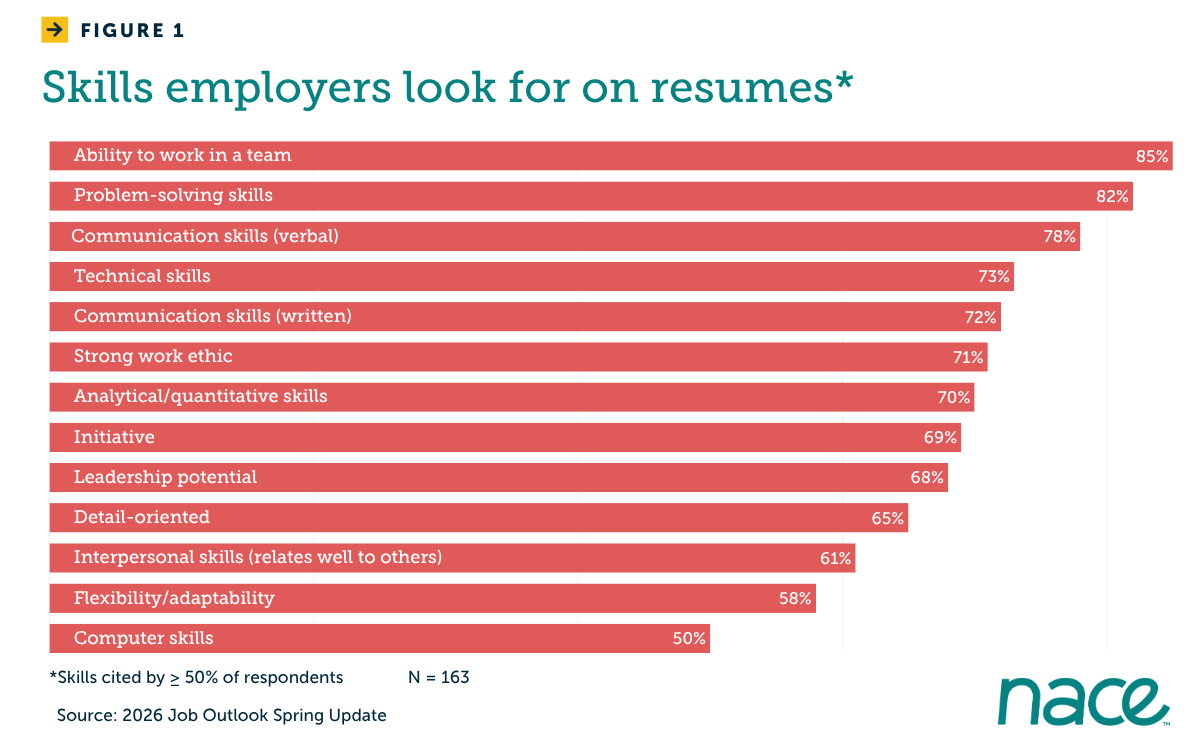
NACE’s Job Outlook 2026 Spring Update survey found that, in particular, employers want to see that candidates have the ability to work in a team, problem-solve, and communicate effectively, but their “wish list” is extensive, with more than half of respondents citing 10+ skills. (See Figure 1.)
Other attributes and qualities employers value include technical skills, a strong work ethic, and sharp analytical/quantitative skills. These closely with the skills NACE has identified as critical for students to develop to successfully transition to the workplace.
However, Shawn VanDerziel, NACE president and chief executive officer, emphasizes that It is not enough for candidates to simply list their skills: Employers want to see examples.
“In a recruiting environment that is increasingly based on skills that translate to the workplace instead of GPA and major, it’s important for students to reflect on their academic, experiential, extracurricular, and work experiences to identify the skills they have sharpened and connect them to the jobs for which they are applying,” VanDerziel explains.
“They also need to prepare to further articulate their proficiency in these key skills during interviews and in other interactions with recruiters.”
How do students know what skills to highlight? Previous NACE research found that many organizations highlight the skills needed for the position when creating their job descriptions. Some employers even provide students with examples of the questions they will be asking prior to interviews.
Colleges and universities can also help students prepare by apprising them of the skills that employers covet and then working with them to reflect on and articulate their skills and how they apply to the job, employer, and industry.
“Another advantage for students is having internship experience. This is especially important in a competitive job market such as this. NACE research consistently finds that when deciding between two equally qualified job candidates, employers overwhelmingly choose the candidate who has internship experience,” VanDerziel says.
“This is because internships are rich with workplace experience and skills development that students carry with them into their careers.”
About the Job Outlook 2026 Spring Update: The Job Outlook 2026 Spring Update survey, sponsored by Jobscan, was conducted from February 12 – March 17, 2026. Of the 185 total respondents, 142 were NACE employer members, representing 19.9% of eligible member respondents. The Job Outlook 2026 Spring Update survey was also distributed to nonmember companies; this group provided an additional 43 responses. The survey updates hiring projections for the Class of 2026 that was published in November 2025.
About the National Association of Colleges and Employers: Established in 1956, the National Association of Colleges and Employers (NACE) is the only professional association in the United States that connects more than 14,500 college career services professionals, nearly 2,900 early career talent acquisition professionals, and more than 400 business solution providers that serve this community.
NACE is the premier source of market research on career readiness, the employment of recent college graduates, and the college-to-career transition. NACE forecasts hiring and trends in the job market; tracks salaries, recruiting and hiring practices, and student attitudes and outcomes; and identifies best practices and benchmarks.
NACE offers its members unparalleled research, networking and professional development opportunities, guidance on standards and ethics, and advocacy on key issues. For more information, visit www.naceweb.org.