Join/Renew





In terms of starting salary, is there a benefit in obtaining a master’s degree?
Average starting salaries taken from NACE’s Salary Survey reports in 2016 and 2022 and adjusted to and
compared with 2025 levels show that there is a salary advantage for college students obtaining a master's degree across six majors: computer sciences, engineering, business, engineering technologies, healthcare, and math and statistics.
However, for several of these majors, the differential between average starting salaries of recent graduates earning bachelor’s degrees and master’s degrees has diminished over the past decade. It is important to note that this has been a
period of wild turbulence within the job market, rocked by a global pandemic, lifted by a swell in hiring afterward, and further jostled about by economic uncertainty.
That said, graduates earning business degrees are the only group that has seen its salary differential increase across these years. Their salary differential between the degree levels stands at 39%, up from 37.4% in 2022 and 32.7% in 2016. (See Figure
1.)
Engineering graduates earning master’s degrees saw their differential climb more than 12% between 2016 and 2022—to 29.9%—before experiencing a 3.7% drop to 26.2% in 2025.
For other majors—computer sciences, engineering technologies, and healthcare—the differentials are near or exceed 20%, although the differential for engineering technologies has tumbled 15% and that for healthcare has fallen more than 25%
since 2016. Even the advantage for master’s grads in computer sciences has dipped, dropping more than 9% from 2016.
The fact that engineering and computer sciences graduates have lost ground in terms of advanced degree salary differential is particularly intriguing, especially given the consistent high demand for these graduates.
Unfortunately, for math and statistics graduates, the salary benefit of earning a master’s degree has all but disappeared. In 2016, math and statistics graduates with master’s degrees enjoyed a differential of more than 50% over their counterparts who earned bachelor’s degrees. In 2025, that differential has shrunk to just 2.4%.
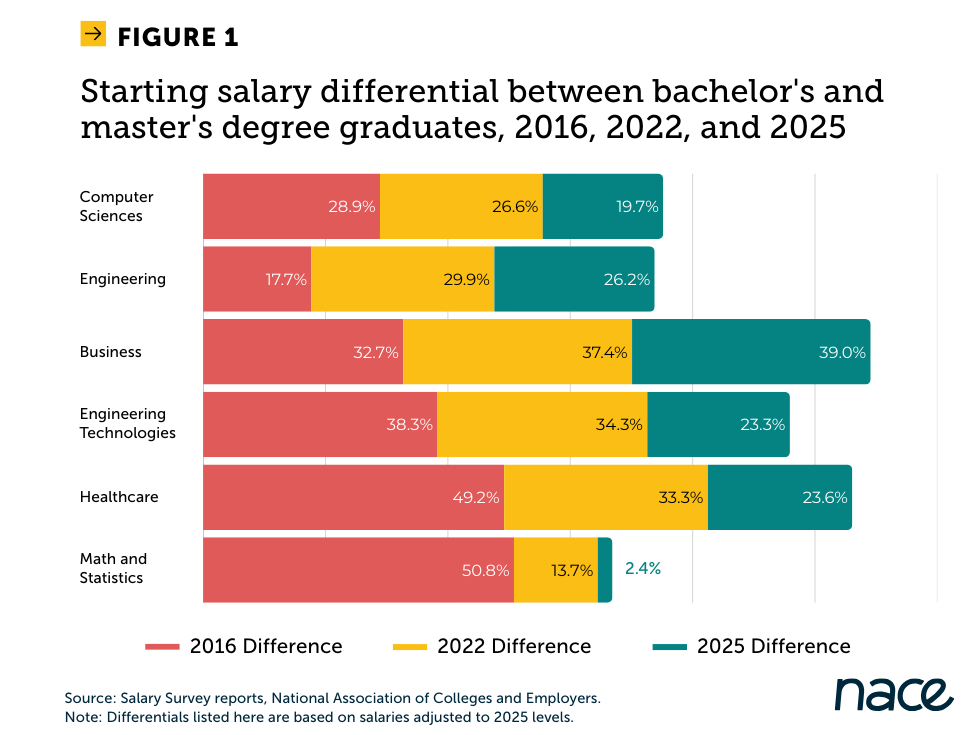
Figure 2: Actual and adjusted salaries for bachelor’s and master’s graduates, 2016, 2022, and 2025
| Major | Bachelor’s Degrees | Master’s Degrees | ||||
|---|---|---|---|---|---|---|
| 2025 Actual Salary | 2022 Adjusted Salary | 2016 Adjusted Salary | 2025 Actual Salary | 2022 Adjusted Salary | 2016 Adjusted Salary | |
| Computer Sciences | $88,907 | $89,305 | $92,619 | $106,374 | $113,039 | $119,343 |
| Engineering | $80,482 | $78,653 | $85,326 | $101,544 | $102,159 | $100,413 |
| Business | $68,644 | $62,893 | $68,851 | $95,399 | $86,383 | $91,386 |
| Engineering Technologies | $71,296 | $69,021 | $72,684 | $87,919 | $92,704 | $100,549 |
| Healthcare | $63,608 | $59,535 | $66,709 | $78,592 | $79,339 | $99,543 |
| Math and Statistics | $78,543 | $75,808 | $78,355 | $80,441 | $86,191 | $118,176 |
Source: Summer 2025 Salary Survey, National Association of Colleges and Employers. Note: Salaries listed here are adjusted to 2025 levels.