Join/Renew





Not all college students fit the same mold as an 18-year-old navigating dorm life, exploring their interests, and preparing themselves for their career. Some are returning learners or professionals pursuing advanced degrees while balancing work, family, and other responsibilities. These students can bring different perspectives and priorities that shape their engagement with coursework, skill development, and career preparation.
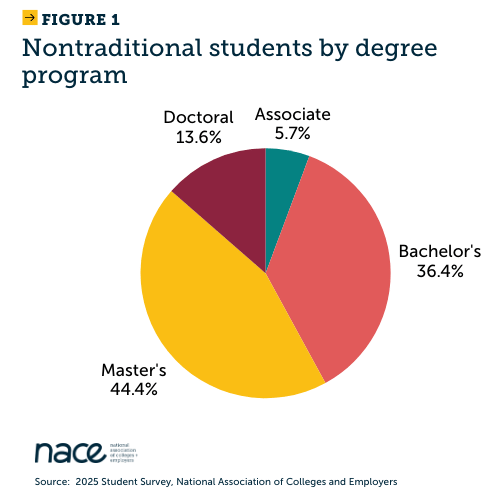
To understand their experiences, we analyzed data from our 2025 Student Survey to provide a snapshot of the experiences of nontraditional students, defined here as students 25 years and older and enrolled in undergraduate and graduate degree programs. (See Figure 1.) Nontraditional students comprised approximately 11% of the sample (N = 1,547), with traditional students making up the majority (N = 4,902). This article focuses on the experiences of this sample. (Editor’s note: Throughout the article, percentages are based on the number of responses to the individual question.)
Last year, our analysis of the 2024 Student Survey data showed that nontraditional students were less likely to engage with campus resources but felt more confident that their institutions were preparing them for their careers. Building on that, this year we explored how nontraditional students are navigating AI, skill development, their sense of belonging on campus, and how they compare to their traditional-aged peers.
Nontraditional students and AI
While the overall use of AI for job search is relatively similar between traditional and nontraditional students, how they are using it differs.
According to our survey, about a quarter of nontraditional students have incorporated AI into their job search,, and an additional 15% plan to use it once they start job searching.
Similarly, nearly 24% of traditional students are using it in their job search and 11% plan to do so in the future.
However, among nontraditional students taking part in our survey, the most common use is writing cover letters and creating resumes, with more than 60% of respondents choosing this reason. Conversely, a majority (63%) of traditional students use AI to prepare for interviews.
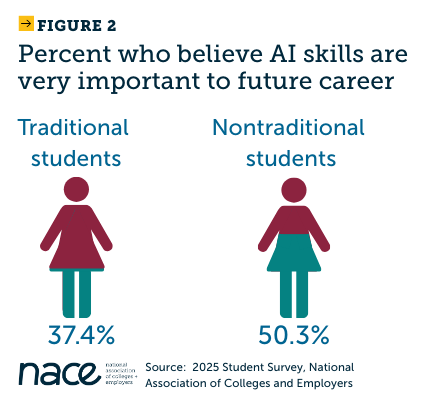
In addition, nontraditional students place a greater emphasis on developing AI-related skills—such as asking effective questions, structuring prompts, and checking AI responses—than their counterparts. More than half view these skills as “extremely” or “very important” for career, compared to only 37% of traditional students. (See Figure 2.)
Despite the strong interest in AI, both groups report having limited training and support from faculty or career centers. More than three-quarters of students in both groups have neither participated in a workshop nor received instruction on using
AI as an assistive tool. Additionally, more than 40% say the career center staff at their college have not suggested using AI in their job search.
Skill development and career center engagement
Both groups report gaining hands-on experience through internships or projects, although engagement is higher among traditional students (75%) compared to nontraditional students (70%). Both student groups say communication, professionalism, and teamwork are the main skills they have developed through internships.
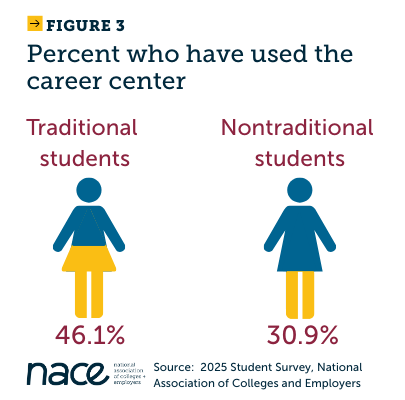
Just over half of nontraditional students reported using the career center compared to nearly 70% of traditional students. (See Figure 3.)
In terms of career readiness, both groups feel confident articulating their career and self-development, communication, leadership, teamwork, and critical thinking skills to employers. However, a slightly larger percentage of nontraditional students are confident when talking about their technology-related skills and those that address equity and inclusion. About 84% of nontraditional students report they can clearly explain their technology skills to employers, compared to 80% of traditional students. Similarly, around 77% of nontraditional students are confident in articulating equity and inclusion skills compared to 73% of their traditional peers.
Belonging and connection
Both student groups report a strong sense of belonging and pride in their institution, but traditional students report greater comfort and connection on campus, including with peers and career center staff. For example, more than half of traditional students said they are comfortable on campus compared to 40% of nontraditional students. Similarly, almost 40% of traditional students report feeling connected to others while fewer than 30% of nontraditional students say the same.
Nontraditional students are less likely than their traditional peers to feel welcome in the career center or comfortable seeking career development support from its staff. Just over half (53%) of nontraditional students said they “somewhat agree” or “strongly agree” that they feel welcome in the career center, compared to 70% of traditional students. Similarly, 62% of nontraditional students reported feeling comfortable asking career center staff about career development, while 71% of traditional students said the same.
At the same time, nontraditional students do feel supported within their major. Specifically, 76% of nontraditional students agreed or strongly agreed that they are supported by peers, compared with 81% of traditional students. Likewise, 81% of nontraditional students agreed or strongly agreed that they are supported by faculty, close to the 82% reported by traditional students. Nontraditional students also reported slightly higher levels of pride in their school affiliation (54% for nontraditional students and approximately 49% for traditional students).
These findings highlight a challenge and an opportunity for career centers to create support systems for nontraditional students, so they feel a deeper sense of belonging.
Based on these findings, institutions of higher education can implement strategies to enhance college experiences and career outcomes among nontraditional students.
What the data tells us and what we can do
Nontraditional students are an important segment of the student population, accounting for more than a third of all college students. The data suggest career centers may need to create support systems and more opportunities for connection that address the unique needs of nontraditional students. For example, career centers can:
- Host networking events outside of standard hours;
- Develop alumni or peer mentorship programs specifically for nontraditional students; and
- Create flexible virtual drop-in office hours so nontraditional students have more opportunities to connect with the career center staff.
Our results suggest that institutions also can provide additional support to nontraditional students by expanding access to experiential learning programs. For example, institutions could award academic credit for participating in internships outside the classroom and create remote project-based opportunities.
By addressing the needs of nontraditional students, career centers can better support their preparation for the next step in their careers and create more inclusive and supportive college experiences.