Join/Renew



How holistic mentorship can transform belonging, engagement, and the future of work
Our workplace as we know it, once thought of as a hub for teamwork and creativity, has unfortunately become fragmented. Even with numerous options to connect and exchange information online, many professionals still experience a feeling of disconnection.
Burnout is no longer in the margins and a peripheral issue—it has become a widespread reality. According to a 2025 survey, 66% of employees reported experiencing job burnout—an all-time high.1 At the same time, Gallup reports that employee engagement in the United States has declined to an 11-year low, with only 33% of employees feeling actively engaged in their work.2
These figures signal a deep and pressing issue—a collapse in the way individuals discover purpose, relationships, and a sense of self in their personal, career, and professional settings. This transition calls for a profound rethinking.
Rethinking Engagement
The most human-centered workplaces of tomorrow will not emerge from trends or analytics; they will be products of multi-year reimaginations. They will be intentionally crafted and strategically designed by leaders who recognize that connection, belonging, and growth must be present, visible, and balanced. Moreover, these elements must be integrated and felt across an organization's cultural fabric from the ground up. In these new spaces, belonging is inspired by leaders with intentionality. This represents a paradigm shift in how we design, frame, approach, and understand belonging.
This article presents a transformative and holistic framework aimed at restoring and reinventing workplace connectedness. This framework is built upon intentional mentorship, human-first leadership practices, and identity-affirming development strategies. Rather than simply offering tools or tactics, we are proposing a mindset shift—a cultural architecture—that positions connection and mentorship as non-negotiable essentials in any flourishing workplace.
Our goal is to equip career services professionals, human resources leaders, and senior higher education administrators with actionable insights to rebuild synergy, engagement, and purpose.
The Disconnected Era: The Human Cost of Fragmentation
Digital connection frequently replaces significant human interaction. In the modern workplace, digital interactions have surged to unprecedented levels in history, yet we find ourselves feeling more disconnected emotionally, spiritually, and relationally. Since the pandemic, the transition to remote and hybrid work models has offered important flexibility but it has also reduced the impromptu interactions that used to help build emotional bonds.
In 2023, the U.S. Surgeon General issued an advisory declaring loneliness a public health crisis.3 This epidemic of disconnection is not confined to our personal lives. It is making its way into our workplaces—places that were once built on community, collaboration, and shared ambition. The fragmentation of workplace culture means that individuals no longer see a shared vision in their work, and they struggle to find meaning or find themselves as integral to a collective mission.
Consider that a 2024 Gallup study found that organizations investing in employee development report 11% greater profitability and are twice as likely to retain their employees.4 The study highlights that employees seek workplaces offering purpose and development opportunities, and "career growth opportunities" are the top reported reason individuals cite for changing jobs.
Similarly, the 2022 Workplace Learning & Development Trends report by SHRM and TalentLMS revealed that 76% of employees are more likely to stay with a company that offers continuous training.5
Taken together, these findings suggest that we need a new type of mentorship—one that goes beyond traditional paradigms and repositions connection at the core of professional development.
Wired for Meaning: The Four Layers of Connectedness
Human beings are neurologically hardwired for connection. Workplace connectedness represents a concrete concept that functions as both a fundamental structural element and an intimate personal experience. The degree to which individuals experience meaningful alignment with their work environment defines workplace connectedness. This connection exists across four distinct but interdependent layers:
- Connectedness to self is the starting point of understanding personal values combined with strengths, goals, and inner motivations. People who understand their inner selves demonstrate better decision-making skills and show resilience during challenging situations while ensuring their professional paths reflect their true selves. Internal coherence leads to natural motivation while providing clear direction.
- Connectedness to the team is built on trust, shared accountability, and open lines of communication. The foundation of high-performing team connection rests upon mutual trust together with shared accountability and transparent communication. High-performing teams first define success for themselves. They don’t adapt their definition of success to their external audiences. Every voice matters, so success is achieved through psychological safety, rather than solely relying on skills or intelligence.
- Connectedness to the organization helps individuals understand how their daily actions contribute to the organization’s shared mission, values, and long-term vision. Connectedness within an organization is visible in its culture and is reflected through the collective impact of the daily work. Employees should not be operating in isolation and performing tasks without understanding the larger connection to progress as this causes misalignment.
- Connectedness to clients or communities served is where purpose lives. When people view the effect that their work has on others, they experience more satisfaction in their roles. This external impact fuels internal motivation. Employees' work turns into meaningful contributions beyond just being a job.
When these four layers are strong, individuals are able to operate with passion and clarity. Mentorship, when designed with these layers in mind, acts as connective tissue—linking people not only to one another but also to meaning itself. This starts
from the first day of onboarding.
Onboarding: From First-Year Experience to Lifelong Integration
In many workplaces, onboarding is treated as a business contract. It’s a brief orientation period filled with mandatory compliance videos and lots of paperwork.
What if we treated the first year of employment like the first year of college? What if we replaced onboarding with an intentional belonging journey that included relationship-building, mentorship, identity affirmation, and cultural immersion?
The data make the case for this redesign. Deloitte reports that 49% of Generation Z and 44% of Millennials feel anxious most or all of the time due to workplace pressure and lack of support.6 Robert Half research reveals that 91% of employees would consider leaving a new job within the first month if expectations are not met.7 According to Oak Engage, proactive onboarding programs increase employee retention by 82%.8
Meaning and Belonging
Belonging represents “lived experiences”—representing experiences that are meaningful, recognized, and respected. This is not something that happens by accident or naturally in most workplaces, as it must be intentionally built based on authenticity. Every person on every team has an identity. How many organizations help individuals align with their true selves? Isn’t this alignment critical to understanding both a sense of belonging and purpose?
True belonging needs to be integrated into an organization’s infrastructure, foundation, and energy. From hiring practices based on principles and values to onboarding systems that help individuals understand what it means to work at that organization, belonging must be thoughtfully co-designed.
We have worked with diverse employee populations across sectors—from international students adjusting to U.S. work culture to mid-career professionals managing cultural differences to Generation Z professionals who expect authenticity and inclusion from day one. What these individuals have taught us is that belonging is contextual. It is personal. It requires listening, empathy, and co-creation.
For instance, introducing preboarding touchpoints—like personalized welcome messages, introductions to affinity groups, or meet-your-mentor sessions—sends a powerful signal that identity and inclusion matter.
Belonging also requires that difference is not only acknowledged but celebrated. It is not enough to make space for people of varying backgrounds, perspectives, and identities. Those differences must be integrated into the organization’s leadership pipeline, innovation processes, and decision-making frameworks.
Leaders play a critical role in designing belonging. The systems should respect individual identity while creating safe psychological environments.
Redefining Growth Through Mentorship
Despite 80% of professionals acknowledging the importance of networking, only 40% report having access to a mentor at work.9 That statistic reveals a cultural disconnect. Too often, “networking” is transactional—based on short-term gain rather than long-term growth. People are encouraged to collect contacts rather than cultivate connections.
Trust together with shared goals and mentorship form the foundation for real connectedness. Structured mentorship programs in organizations lead to better employee retention and drive both innovative thinking and leadership development.
Gallup reports that employees with mentors demonstrate five times higher engagement levels.10 Structured mentorship programs show 72% retention for mentees and 69% for mentors, exceeding the 49% retention rate of those not participating in such programs.11 These are not just numbers. They are indicators of cultural health.
Effective mentorship can exist outside of formal structures, but it must be intentional. Organizations need to make mentorship standard practice within their onboarding processes, team structures, and leadership pipelines. Our workplaces can become talent-rich environments that unleash creativity and build loyalty when we make mentorship a priority.
How Holistic Mentorship Rewires Culture
Holistic mentorship—when a core component of the organization's culture—becomes a powerful lever for systemic transformation. It fosters psychological safety, strengthens cultural cohesion, and unlocks human potential at scale.
At the individual level, mentorship cultivates career and life vision clarity, courage, and confidence. As a high-performing team, it deepens collaboration, encourages feedback, and strengthens shared accountability. At the organizational level, it supports talent development, knowledge transfer, and succession planning. At the stakeholder level, it ensures employees are connected to purpose.
Mentorship should not be viewed as a top-down initiative for junior staff. It must be networked across roles and functions.
None of this happens without intention. It requires infrastructure: mentor training, match facilitation, feedback loops, and visible executive sponsorship.
Proven Mentorship Models That Scale Culture and Inclusion
We all know that there is no one-size-fits-all mentorship model that works everywhere, but here are five examples of effective mentoring models:
- Peer mentoring is based on collaboration, mutual support, shared learning, and accountability, typically between colleagues of similar experience levels. This level of support builds friendship and humanizes help-seeking. When this model is facilitated with structure, it accelerates onboarding, integration, or re-integration, and reinforces cultural fluency, which can have a very positive impact on the overall team dynamics.
- Reverse mentoring, which isn’t seen much, is when junior employees mentor senior leaders on topics such as emerging technologies and generational trends. This model challenges assumptions, flattens hierarchies, and provides an opportunity to share perspectives with the C-suite.
- Diversity mentoring programs connect underrepresented employees with senior advocates, accelerating careers and helping individuals manage up. A Harvard Business Review study found that mentoring increases minority representation in management by 24%.12
- Mentoring circles are probably one of the most underrated models, bringing together small groups of people with shared interests and affiliations. A facilitator is present to guide conversations on personal, career, and professional development themes. This model is ideal for building community across departments and inspiring collaborative learning.
- Affinity-based mentoring connects people through their disclosed and shared identities, such as first-generation status or having similar language, racial, cultural, gender, or lived experiences. and helps build confidence and psychological safety.
Mentorship models are optimized when the matching isn’t automatically done on behalf of the mentees. While it’s still very useful to match employees internally, the ultimate goal is to teach and help individuals understand how to seek out mentors on their own and/or self-select.
The Mentoring Impact Model
The Mentoring Impact Model shows how mentoring leads to sustained systemic outcomes through the strong connections of mentoring, workplace connectedness, and belonging. (See Figure 1.) Organizations can leverage this model to maximize their mentoring
investments.
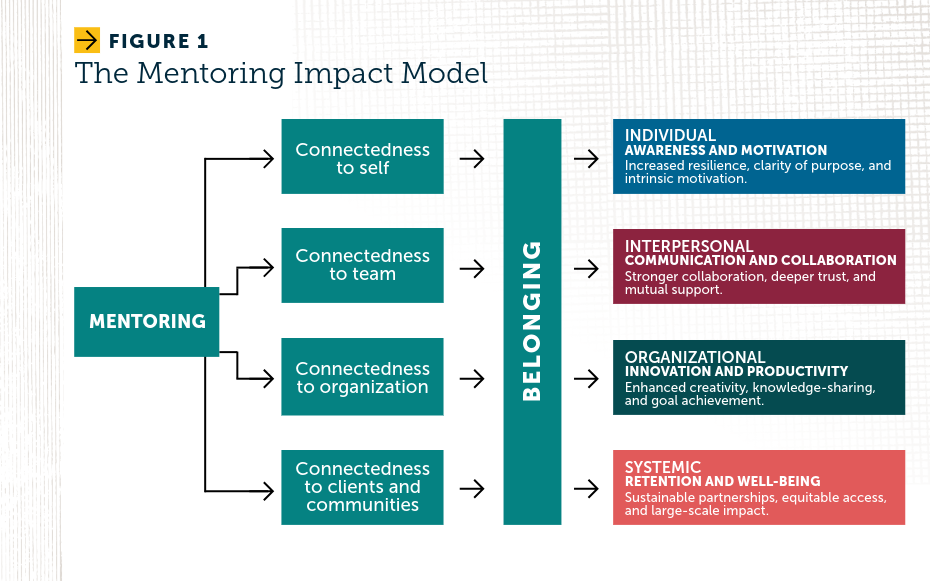
Figure 1 courtesy of Yasir Kurt
Mentoring helps organizations build healthy and strong connectedness in the workplace. When employees experience strong connectedness to themselves, their teams, and the workplace itself, their sense of belonging at work grows stronger. Eventually, belonging leads to positive outcomes across individuals, teams, organizations, and systemic levels.
At the individual level, belonging increases self-awareness and motivation, leading to stronger interpersonal connections at work. The employees who are motivated and connected with their team members generate innovative ideas and become more productive,
leading to organizational achievement. Ultimately, belonging enhances employee well-being and contributes to systemic improvements such as higher retention, sustainable relationships, and quality products and services, as a result, a larger scale
of impact.
Redesigning the Future of Connected Work
Annual retreats do not create belonging; rather, daily rituals, inclusive systems, and courageous conversations do. The future workplace will not be defined by perks or platforms. It will be determined by its ability to build trust.
As AI continues to automate technical tasks, what remains—and what becomes increasingly essential—are human capabilities: empathy, relationship-building, collaboration, and resilience. These are the skills that will distinguish high-performing teams from those that simply keep pace.
The most competitive organizations will be the ones with the most intentional human culture. Workplaces that prioritize connectedness in their design will retain talent, unlock innovation, and sustain well-being on a scale.
The question becomes, how do we get there? To move forward, we have to let go of static culture models and start thinking in terms of adaptive design. Real culture change doesn’t happen overnight—it’s something that should evolve continuously.
It starts with:
- Embedding mentorship at every stage of the employee experience.
- Developing leaders who understand the value of emotional intelligence, psychological safety, and inclusive communication.
- Making pathways for growth and feedback that are clear. These channels must be consistent, transparent, and visible. They should also be accessible. Individuals deserve to understand where they stand, and how to move forward—and most importantly, what’s possible.
- Recognizing that shared rituals matter—and they matter a lot. These are those special moments that bring people together from different departments that don’t always talk to each other, that bring diverse identities and roles to a common ground, that make a culture feel alive and human.
- Putting a stop to measuring success only through performance metrics. We have to know how people are and if they feel they belong.
Let’s be honest: The future of work is highly tech-enabled. But, it’s also trust-enabled.
A New Standard of Engagement
We are at a cultural inflection point. The decision is clear: Continue on the path of fragmentation, or design something better. What we design today will define how we belong tomorrow.
The organizations that prosper over the next decade will be those that refuse to treat people as outputs and belonging as optional.
Endnotes
1 Robinson, B. (2025, February 8). “Job Burnout At 66% In 2025, New Study Shows.” Forbes.
2 Harter, J. (2024, January 31). “U.S. Employee Engagement Sinks to Lowest Level in Over a Decade.” Gallup.
3 U.S. Department of Health and Human Services. (2023). Our Epidemic of Loneliness and Isolation: The U.S. Surgeon General’s Advisory on the Healing Effects of Social Connection and Community.
4 Harter, J., & Mann, A. (2024). High-performance Workplaces Do Things Differently. Gallup.
5 Society for Human Resource Management & TalentLMS. (2022). Workplace Learning & Development Trends Report 2022. SHRM Research.
6 Deloitte. (2023). 2023 Gen Z and Millennial Survey. Deloitte Global.
7 Robert Half. (2018, June 4). “Nine in 10 New Hires Would Leave Job That Fails to Meet Expectations Within the First Month.”
Robert Half press release.
8 Oak Engage. (2024, November 27). “24 Shocking Employee Onboarding Statistics You Need to Know in 2024.” Oak.com.
9 Sinek, S. (2014). Leaders Eat Last: Why Some Teams Pull Together and Others Don’t. Portfolio/Penguin.
10 Gallup. (2023). “Mentors and Sponsors Make the Difference.” Gallup Workplace.
11 Klein, K. & Cappelli. P. (2007, May 16). “Workplace Loyalties Change, but the Value of Mentoring Doesn’t.”
Knowledge at Wharton.
12 Dobbin, F., & Kalev, A. (2016, July 20). "Why Diversity Programs Fail." Harvard Business Review.