Join/Renew





In fall 2019, the University of Vermont (UVM) launched six Career Interest Groups (IG). This service delivery model, focused on equity and relevancy, aspires to help students build their employability capital by inviting them to “come join the networks we’re building together” instead of telling them to “go network.”
In 2024, UVM executed a robust programmatic evaluation to assess the efficacy of the IG model by looking at engagement, networking self-efficacy, proximal networking benefits, and social identities. Data revealed that while members were not as engaged as the career center had hoped, those who did engage saw direct benefits at a 1:1 correlation, with higher benefits for students of color. IG members reported moderate levels of networking self-efficacy—higher than expected and higher for male-identified members. Qualitative data revealed that members had a solid understanding of the purpose of the IG networks, but not of the active role they need to play in leveraging the networks. When combined, identity, engagement, and self-efficacy accounted for 41% of the variance in networking benefits—with engagement having the greatest magnitude. This research informs programmatic evolutions at UVM with the hope that lessons learned on this campus might also inform practitioners elsewhere. Despite growing national interest on models like this, there is little research on them.1
This article examines the evaluation, its results, and the implications of our findings.
UVM’s Interest Group Model
Informed by the national conversation on the value of network development and a clear imperative for such efforts to be intentionally inclusive, UVM overhauled its service model in the fall of 2019, replacing a focus on 1:1 counseling with a service model that aims to connect students with relevant people (alums, peers, employers, faculty, staff), opportunities (jobs, internships, events, informational interviews, job shadows, research), and resources (career tips, tools, guides, reflections). Ideally, the groups create a cycle in which people may open doors to opportunities and/or resources, opportunities may connect members with people and/or resources, and resources might lead members to people and/or opportunities. We launched our career interest groups in the fall of 2019. The six groups reflect broad focal areas at the university: arts, media, and communication; business and entrepreneurship; education, policy, and social impact; food, environment, and sustainability; health professions; and STEM. Students are invited to join these groups, rather than advised to simply build networks on their own.
Ultimately, the IG model aims to develop the employability capital of the members so that they graduate possessing a potent combination of human capital (know-how or skills), psychological capital (personal fortitude or grit), social capital
(relevant professional ties), and cultural capital (savvy in using cultural goods/symbols/ideas and credentials as resources in social interactions), making them attractive to potential employers and able to navigate a career journey which may involve
upwards of 12 different jobs. 2,3,4 5 Greater than the sum of its parts, employability capital is key to graduates being—and feeling—career-ready, i.e., having the skillset, mindset, and network to succeed in their
postgraduate pursuits. To this end, UVM’s IG model intended to serve students by helping members leverage the social capital of the UVM network, while encouraging them to identify and articulate their human capital (through reflective prompts),
expand their cultural capital (through job shadows, internships, and the like), and develop their psychological capital (through efficacy-building experiences). IGs were designed to benefit everyone, while potentially offering the most benefit to
those who started college with limited capital (due to their socioeconomic status or marginalized identity).
Theoretical Context for UVM’s IG
Countless theories have emerged on how we learn, work, and navigate the world of work—constantly and necessarily shifting in response to national workforce demands and emerging theoretical developments. Evident in this collection of theories is the persistent tension between human/psychological capital (what I know and what I can do) and social/cultural capital (who I know and where I fit in). For this reason, Social Cognitive Career Theory (SCCT) stands out in its ability to factor both individual agency and social determinism into a theoretical understanding of career development process. UVM’s IG model is built on SCCT and the network approach to Social Capital Theory.
SCCT suggests that an individual’s career interests, goals, and pursuant actions are influenced by their career self-efficacy beliefs. SCCT further suggests that career self-efficacy beliefs are influenced by one’s learning experiences, which are directly impacted by environmental and personal factors. That is to say, a person’s sense of self-efficacy is directly influenced by the experiences they have had—which are a result of who they are and where they came from—and will directly impact their behavior going forward, including what interests they decide to pursue, what goals they set for themselves, what actions they take to meet those goals, and, ultimately, what attainments are gained from such efforts. Moreover, SCCT notes that this process happens within the context of social structures (which provide both supports and barriers) and happens because of the cognitive processes through which individuals make meaning of their experiences.
Core to SCCT is Bandura’s foundational work revealing that high self-efficacy—or a positive belief in one’s ability to organize and execute actions required to achieve desired goal—is an influential predictor of whether an action will be initiated, with how much effort, and how long the effort will be sustained in the face of obstacles.6,7 Of course, self-efficacy is domain-specific. A person may feel very confident in sports but not with foreign languages. Or, in the case of career readiness, students may feel confident in career exploration, but less so in career decision-making or networking.8 Importantly, Bandura also found that self-efficacy beliefs are not fixed but, rather, are acquired and modified via four principal sources of information or learning experiences: 1) personal performance accomplishments (mastery experiences), 2) observing others (vicarious learning), 3) verbal encouragements (social persuasion), and 4) physiological and affective states (productive emotions).9
UVM’s model aims to afford IG members efficacy-building learning experiences through their participation on UVM Connect (the virtual home of IGs), at IG events, and by consuming relevant newsletter content. For example, a student might use UVM Connect to find and reach out to an alum in their interest group and thus enjoy a sense of success, leading them to feel more confident about networking. Similarly, if members read their newsletters or attend an event, they might observe other students having success and learn vicariously from them and/or experience some degree of social persuasion, i.e., inclination to do as others like themselves are doing. Finally, we presume that engagement with the interest group will help assuage career anxieties as members feel more informed, more in control by taking active steps toward career readiness, and more confident through increased experience.
Social Capital Theory—the second theory on which UVM’s IG model is grounded—posits that relationships matter, that “social networks are a valuable asset,” and that social capital is “the strength of an individual’s social network and community.”10,11 Unfortunately, students from “underserved backgrounds often come to college without adequate socialization to careers or exposure to sources of self-efficacy.”12 Such differences can have a significant impact on one’s perceived employability and self-efficacy, and can produce differences in career outcomes.13 Moreover, when people network only with those already in their circles, the strength of their network, and thus their social capital, is consequently limited.
Social Capital Theory acknowledges multiple types of networks, each with unique benefits. UVM’s IGs are designed to be bridging networks, capitalizing on structural holes and affording members access to networks across differences. Distinct from bonding networks (where one might expect to find a shared identity or deep sense of belonging) bridging networks “link people across a cleavage that typically divides society (such as race, class, or religion)” so they can access the insights of others, affording the networker strategic information that may help them get ahead.14,15 Of course, we all need both bridging and bonding networks. Dense bonding networks, such as those formed through campus identity centers, may provide psychosocial support in ways that broad, diverse bridging networks do not. IGs aim to complement strong bonding networks by helping all students gain access to more expansive networks to build their social capital, as part of their employability capital.
Both SCCT and Social Capital Theory recognize the impacts of societal barriers upon an individual’s agency. SCCT understands societal barriers as both antecedent and ongoing influences on one’s engagement in career self-management. The choices
students make are made within social structures that define and confine their expectations. Just as the absence of a network could present a barrier, e.g., I do not know any women in STEM therefore I do not see a path for myself in STEM,
access to a network can provide support to set and act upon goals. Thus, bridging networks like the IGs provide critical supports to counter societal barriers.
Defining networking and networking benefits
Broadly speaking, networking refers to purposeful efforts to connect with others for mutual benefit. Networking became central to career services pedagogy between 1990-2010 and has become no less important over the past two decades.16 As the authors of a 2021 article noted, “as the nature of work and career is changing, developing and maintaining relationships is essential for securing employment. Making social connections from the early stages of tertiary education is important to building and maintaining social capital.”17 Perhaps now more than ever, workers are having to “deal with unpredictable and dynamic career environments which call for more self-directedness in career development.”18 Such self-directedness includes taking more initiative in career-forward behaviors like networking.19
Despite general agreement on the enduring utility of networking, it is far from a beloved activity. To many, the idea of networking to build instrumental ties and get ahead feels morally questionable. As a result, even those who know how to network and understand its importance may choose not to network.20 Remembering that SCCT posits that job seekers are more likely to pursue interests in which they feel self-efficacious and have positive outcomes expectations, it would follow that job seekers who feel confident networking and expect reasonably positive outcomes from networking would be more likely to engage in, and thus benefit from, networking. Conversely, job seekers with low self-efficacy would likely be hindered by negative thinking and stress.
With this in mind, researchers developed an online networking intervention for job seekers (based on Bandura’s social cognitive theory) and found that “job seekers can improve their networking quality” through efficacy building experiences.21,22 While networking is often thought of as a “long game,” this researcher was particularly interested in proximal networking benefits or the immediate value achieved from networking.” Proximal networking benefits include:
- Solutions provided by others;
- Referrals to other sources of information (suggestions of other individuals who can provide information or insight);
- Problem reformulation (helping the person define an issue or think about something in a different way);
- Validation (reassurance for the person that their thoughts about an issue are sound or boosting of confidence); and
- Legitimation (so that the individual can say they spoke to someone about an issue).23
Job seekers, however, “often underutilize proximal networking benefits” and therefore, need opportunities to reframe how they understand and relate to networking in addition to learning how to network and engaging in opportunities to practice networking. 24
Class-based messaging also plays a role. A 2018 study of primary schools found that low-income families taught their students to be self-sufficient at all costs, not to burden others, to use what she termed strategies of deference—in a direct rebuke of the “lazy poor” stereotype. Meanwhile, high-income families were teaching their students strategies of influence—that people are resources and should be leveraged readily.25 If we apply this same thinking to college students, it is not hard to imagine that the advice of a career coach to “go network, because many jobs are found networking” would fail as it would run counter to the family’s teaching not to bother others. Once again, this illustrates how structural supports—like the IG networks—are necessary to counter the social barriers that can deter the very students who stand to benefit most.
Assessing the IG Model
In our fourth year of this new model, I set out to assess if it was working: Were IG members benefiting from their membership? More specifically, to what degree they were engaging in networking activities, what was their level of confidence or networking self-efficacy (NSE), and what proximal networking benefits did they report?
As the IG model was specifically designed to promote equitable access to connections and experiences for all, regardless of background or social capital, I also wanted to know if their engagement, self-efficacy, or benefits were moderated by their social identities, or if any relationship existed between identity, engagement, and self-efficacy on benefits. Lastly, I asked members how they would describe the purpose of an IG to a classmate to understand what sense they were making of the IGs. I hypothesized that members whose understanding of the IG purpose aligned with the intended design would engage more. I further hypothesized that those who reported higher levels of confidence and engagement would report greater benefits and that members with privileged social identities, high networking self-efficacy, and high levels of engagement would realize greater proximal networking benefits.
The survey was conducted in spring 2024 with the support of career center staff and the Office of Institutional Research and Assessment. Following a non-experimental cross-sectional design, I administered an anonymous survey to 4,891 IG members via direct email from the career center, with a $20 gift card incentive. This mixed-methods approach used a survey comprised of both closed-ended (Likert and frequency scales) and open-ended questions. As the real value of a mixed-method approach lies in the convergence of the qualitative and quantitative data, the narrative responses were coded to help explain the quantifiable impacts of interest groups with a more qualitative understanding of how students understand the purpose of interest groups.26 All questions were asked of all participants; however, the open-ended questions were optional resulting in a smaller response rate.
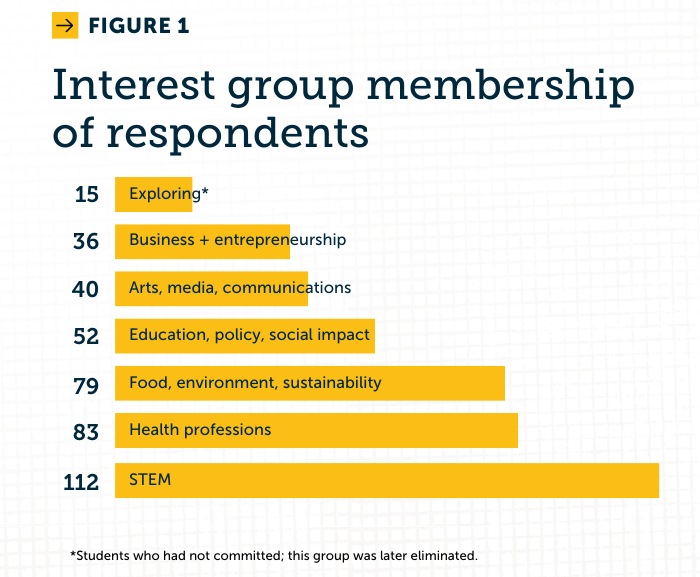
Overall, 307 members responded to the survey. Respondents were from all IGs, with the strongest representation in STEM. (See Figure 1. Note: As is encouraged, 30% of respondents belong to two or more groups so the membership count is greater than 307.) The high response rate from STEM members is likely due to close partnerships with staff and instructors in the College of Engineering and Mathematical Sciences who helped push participation.
Nearly three-quarters—74%—identified as female (n = 226), 14% identified as male (n = 43), and the remaining 12% fell into the beyond-the-binary grouping (n = 36).
Overall, 83% identified as white (n = 254), while 15% were in the students-of-color grouping (n = 47). Respondents were, by and large, continuing-generation students (93%, n = 286), meaning they had one or more parents who completed a bachelor’s degree or higher.
These demographics generally mirror the demographics of the overall undergraduate student body at UVM.
Note: Our sample size of 307—out of a population just shy of 4,900—yields a 95% confidence level, with a 6% margin of error, according to Qualtrics’ Sample Size Calculator. This is sufficient to generalize findings to the population of IG members at UVM, empowering career center staff—and colleagues across campus—to make data-informed decisions regarding the evolution of the IG model and career offerings more generally. By addressing largely unexplored questions on the efficacy of career interest groups as a model for career development on college campuses, I hope it provides insights useful to fellow career practitioners. However, the very localized nature of this survey does limit the generalizability and invite a wider body of research on such models in other settings. And, given that the vast majority of respondents to the survey were white, female, and continuing-generation students, it must also be noted that to fully understand the potential moderators of social identity, further study on students of color, first-generation students, and students who identify beyond the gender binary would be advisable.
Findings
Findings were broken into five categories.
Engagement: Overall, engagement was not high. On a 4-point scale, the mean engagement score was just 0.88.
This lack of engagement is perhaps best explained by comments such as: “[IGs are a] place to connect to alum and others to connect [you] to jobs/internships, but I personally don’t know how it works.” Several similar comments suggested that students were ready and willing to join but needed further guidance on what to do once they joined.
Networking self-efficacy (NSE): Respondents’ confidence to engage in networking activities was just shy of “moderately confident” (average mean for NSE was 1.73, n = 290), with men reporting higher levels of confidence than women and beyond-the-binary respondents.
This tracks with research on gender disparity in leadership that found “females reported…lower levels of self-efficacy [than males] upon entering college.”27 The same study noted that students who feel less confident are less likely to engage in efficacy-building learning experiences and subsequently fail to benefit from self-efficacy development to the same degree of those who do engage.28 Moreover, additional research notes that very competent students with marginalized identities might suffer from low self-efficacy due to false self-perceptions/assumptions colored by stereotypes and prejudice.29 The interaction of gender and first-generation status was also found to be significant. Combined consideration of social identities like this is essential given the impact of intersectionality—the “contradictory and compounded nature of” being both female and first-generation.30 These findings underscore the need for career practitioners to continue to look for ways to foster the development of networking self-efficacy, especially for first-generation students and those who identify as female or beyond the binary.
Benefits: Given the low rates of engagement, it is not surprising that the average reported proximal networking benefits were only 1.25 (on a scale of 0-4). Moreover, a flaw in the survey design forced respondents who had already indicated that they were not actively engaging with the IGs to still rate the extent to which engagement provided benefits. Thus, we can presume that a significant number of zeros recorded for this question were not actually measures of benefits but rather measure of engagement. ANOVA findings did also reveal some difference in benefits due to race, with students of color reporting greater benefits and demonstrating a stronger understanding of the IG purpose.
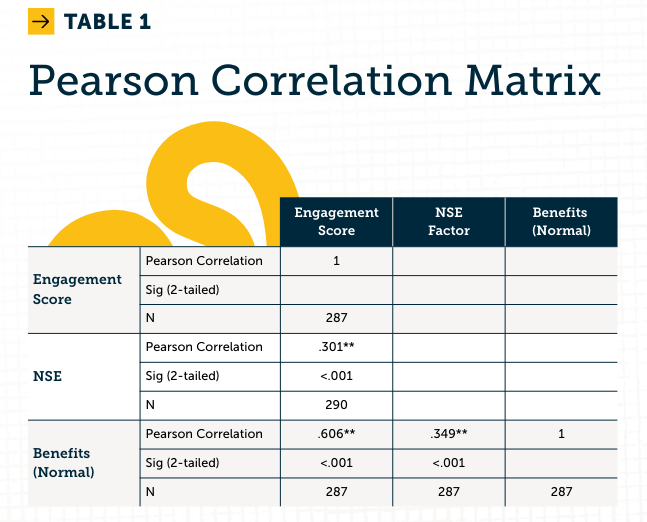
Relationships: The data revealed a strong correlation between benefits and engagement; for every one-unit increase in engagement, benefits increase by 1.13 units on average.
Weaker relationships were also found between benefits and self-efficacy and between self-efficacy and engagement. (See Table 1.)
Additionally, a linear regression confirmed that 41% of the variance in proximal networking benefits can be explained by the combined effects of social identity, engagement, and NSE—a larger portion of variance than any single variable alone—underscoring the need to not get tunnel vision regarding engagement and benefits because the reality is more complex than any singular approach would address.
IG purpose: In asking members to describe the purpose, I hoped to gain an understanding of what they understood IGs to be about. It seemed logical that if members did not understand how they were expected to engage, they would not be meeting these unknown expectations. Indeed, this was one of our findings.
The most common codes in the narrative responses were “networking” (101 references), “help” (64), “exploration” (57), “opportunities” (52), “relevance” (45), “support” (27), “skills/resources” (21), and “not helpful” (21).
Responses about the purpose of IGs ranged from “they are a wonderful tool to help explore new careers or find a completely new one that you didn’t know much about ” and “[they] help you find jobs, internships, and other peers with similar interests and experiences” to my favorite—“IDK, they gave me a mug and sometimes [there are] job fairs.”
Although 11% of those who responded to this question confessed to not really understanding or finding much utility in the interest groups, the majority of members seemed to have a fairly strong grasp on the purpose of the groups. In addition, about half of those who claimed not to understand went on to demonstrate some understanding that was aligned with the IG’s defined purpose.
The remaining 89% of responses focused on the benefits one might expect to gain through membership. One example: “It’s easy to feel behind everyone else in your major, but since joining a career interest group, I feel equipped to find the opportunities and internships that could help me in the field.”
On average, responses included 2.2 of these potential benefits. First-generation students (n = 15) and respondents identifying as beyond the binary (n = 20) did have slightly lower averages (2.0 and 1.8, respectively), suggesting that extra efforts to engage in targeted outreach and support for these audiences would be warranted.
Notably, two respondents offered reflections like this: “There’s a ton of resources within them, you just have to do the work to use them.” That this notion of doing the work to use the IG networks showed up in only two responses illuminates a key insight: Members may not realize the effort and initiative required on their part to fully realize the benefits of IG membership. They seemed to be operating under the assumption that membership was passive and that, having joined the group, the IG would provide for them. This was perhaps the most profound insight for our practice as a career center—understanding that not only do we need to provide students with a platform/access to connect with others, but we must also teach them how to leverage their networks. The original IG model relied too heavily on very high levels of self-directedness and self-efficacy. To address this, we have turned our focus on evolving our six signature networking events (one per IG) to become playful learn-to-network events that make engagement easy while allowing members to experience the benefits of engaging with their network. For example, students interested in careers with a social impact are invited to join the university president and the mayor of Burlington in an annual service project. The service draws the members in, and then we simply help them recognize that they were networking while they were volunteering. We will survey members again in the spring of 2027 to see if we’re making measurable headway.
Implications
We built it, and they came. Now we must teach them what to do next. The key takeaway for career practitioners: It is not enough for students to join and IG—they also need clear guidance and motivation to engage with their networks.
I see real opportunity for career practitioners to carefully consider the proximal benefits members stand to gain from networking and work backward to design curricular elements expressly intended to move the needle on each of these. This level of intentional programmatic development is a logical step for a program at this stage of development. Having built the foundation, it seems appropriate to now focus on developing a supportive curriculum to foster understanding, engagement, confidence, and, ultimately, benefits.
Luckily, the interplay of benefits, engagement, and NSE, as suggested by SCCT and evidenced in these data, creates a virtuous cycle of believing (NSE), trying (engagement), and succeeding (benefits), which means that efforts to advance any individual factor are likely to produce positive results all around.
To increase engagement, the UVM Career Center plans to:
- Evolve our networking events to learn-to-network events that serve as accessible entry points to engagement. We will complement this by teaching networking through class presentations, group sessions, career modules/tutorials, and guerrilla marketing efforts—all with special editions on identity-based topics, such as building a first-generation network.
- Deploy a comprehensive, targeted, and progressive communications campaign to guide students from the time they join through graduation, educating them on how to engage with manageable next steps for wherever they are at.
- Promote the proximal benefits of networking by helping students reframe how they think about networks, see benefits they might be overlooking, and inspire both enrollment and engagement; while also potentially boosting networking self-efficacy as students realize they are succeeding at networking more than they realized.
- Continue efforts to mobilize the campus community to help us engage students in our Interest Groups, networking events, and the like. Most students at UVM are not required to engage in career development work, so we must build our own network of strong allies across campus to inspire, nudge, and reward engagement.
The UVM Career Center has been shifting its business model over the past several years away from the primacy of the student-counselor interaction to adopt a more platform-based approach, bringing together many different stakeholders (employers, alums, faculty, staff, students) and acting as a platform upon which value is exchanged. Having already redefined the mission of the career center, and with relevant technologies in place, the third factor outlined for success in a model like this is where our work lies: building a stronger ecosystem to support engagement in the IGs by students of all identities.31
Moreover, future interventions must speak to members holding a wide range of perspectives, opinions, and concerns about networking. Career practitioners must become adept at communicating the IG value proposition in ways that would resonate even with audiences who may not see themselves as networkers. As practitioners, we focus on leveraging the individual’s capacity and agency for self-direction and realization, but we must never forget the many factors, such as societal and environmental supports and barriers, that individuals must contend with and the degree to which these factors “can strengthen, weaken, or even override personal agency.”32
Looking Ahead
Our program evaluation set out to answer the overarching question: Is the career interest group model working? We found that it is.
Is the model realizing its full potential? It is not, as evidenced by passive membership and low levels of engagement.
Going forward, the UVM Career Center must evolve the IG model to better motivate members to be self-directed actors leveraging these networks. To this end, we will design and prototype a number of interventions while continuing to research this model and expand our understanding of how models like this can capitalize on all the benefits of networking and translate those benefits into career mobility for the next generation.
While this study yielded useful and actionable insights, further research on the model as a tool for career mobility might also consider factors not included here. Finding that the most engaged members do realize the greatest benefits opens an exciting potential to explore what drove the most engaged to engage. A comparative study between interest group members and non-members could also be highly informative. Further research might also explore longitudinal data to determine if IG members report better career outcomes and/or higher satisfaction with the career support provided to them while at UVM.
In a society where the rich get richer and the gap between rich and not rich continually expands, this work—of setting every college graduate up to find gainful, meaningful employment—is critical.33 Moreover, “the entrenchment of social class differences in highly unequal societies also makes connections between people of different social status less likely,” underscoring the vital role of improving access to people, opportunity, and resources across differences. 34
Advancing our understanding of impactful ways to engage students in career preparation is critical for many reasons—from life satisfaction to general well-being—and, notably, because students are investing significant funds to improve their career prospects. To graduate individuals ill-prepared to leverage their degrees for meaningful contributions to society and earn sufficient income to settle student loan debt would be a failure of the promise of education and, some might say, an ethical failing as well.