Join/Renew





A study examined the relationship between HOPE status and student major selection specifically connected to the state of Georgia’s workforce needs.
In 1994, then Governor Zell Mill announced the creation of the Helping Outstanding Pupils Educationally (HOPE) scholarship. The educational policy was considered a dramatic step forward in creating greater opportunities for Georgia students who earned a grade point average (GPA) of 3.00 or higher in high school to enroll at a University System of Georgia (USG) institution. In addition, from the program’s onset, a priority of the HOPE scholarship has been to cultivate a workforce with college-prepared students.1
By 2024, the HOPE program had helped more than 2.1 million Georgia students pursuing postsecondary education in Georgia.2 There has been research focused on individuals who had the HOPE scholarship but did not graduate, but there has been less focus on understanding those who have earned a bachelor’s degree and 1) earned and maintained their scholarship through graduation, 2) were awarded but lost the scholarship prior to graduation, or 3) never earned the scholarship.
To gain this insight, an analysis of individuals who earned a bachelor’s degree from a USG comprehensive institution between 2015 and 2022 was conducted. USG comprehensive universities include Georgia Southern University (GSU), Kennesaw State University (KSU), University of West Georgia (UWG), and Valdosta State University (VSU).
This analysis focused on major selections for among graduates in the three groups described above.3 Primary emphasis was placed on major selections connected to identified workforce needs for the state of Georgia.
Georgia’s Investment in Its Human Capital
The state of Georgia values education highly, acknowledging higher education institutions as vital for nurturing an informed population and driving societal advancement. When individuals have access to education, they can positively contribute and expand the workforce's capacity.
The idea of connecting education with community economic growth was first introduced by Theodore Shultz in 1960 and later expanded upon by Walter Heller, which led to the creation of human capital theory.4
Heller significantly advanced the idea that human capital is essential to the development of economies and solidified the belief that “a rising level of education . . . [is] a key generator of long-term economic advancement.”5
Labor productivity expansion is an essential element when seeking to strengthen and expand an economy. Developing labor productivity is often accomplished through one or more of the following initiatives:
- expansion of the physical capital of workers through the purchase of better machines, tools, and infrastructure,
- improvement of the knowledge capital of the workforce through education and training, the fostering of a new economy by introducing modern technologies to improve the productivity of all workers, and
- the strengthening of relations between public and private sectors to facilitate the working of the labor market and limit economic distortions caused by taxes and passive labor market policies.6
Thus, labor productivity is dependent partly on the development of an educated workforce that has the knowledge and skills to keep pace with various industry areas' needs. Human capital is not just about having workers available but having workers with the appropriate education to complete specific tasks. Human capital theory advances the idea that human beings can increase their productive capacity through greater education and training. This focus evolved to include an emphasis not only on the existing labor market but on determining strategies to support society’s need for effective future workers.7
It is critical for a thriving economy that there be not only an educated workforce but a workforce with the specific education needed to support industry. Effective workforce initiatives seek to integrate government, education, and industry. When these areas are working in tandem, regions have the potential for greater growth and development.8
Education is a critical partner in this work and is the component supporting the advancement of state-specific workforce goals.9 Educational policy must work in tandem with business and government to advance the economic viability of the state. Ensuring that the HOPE scholarship achieves this goal of providing the essential workforce majors for the state is a critical need.
How the HOPE Supports Georgia’s Workforce
To gain greater understanding of how the HOPE scholarship supports Georgia’s workforce, data were drawn from the USG and Integrated Postsecondary Education Data System (IPEDS). The details are as follows:
Individuals who earned a bachelor’s degree from 2015 to 2022 who had matriculated in or after fall 2011 were the focus of the study. The rationale for this time span was that the policies for the scholarship remained consistent during this time.
- From the more than 95,000 eligible individuals, 1,500 were randomly selected to be analyzed. This studied set was determined using 98% confidence level with ± 3% margin of error.
- The pool included 669 bachelor’s degree holders who maintained the scholarship through graduation; 502 bachelor’s degree graduates who lost the scholarship before graduating; and 329 bachelor’s degree graduates who never had the scholarship.
- Majors were classified using the U.S. Department of Education’s Classification of Instructional Programs (CIP) codes.
- Majors were grouped into essential and nonessential workforce categories, based on policy documents, speeches by state leaders, and reports from the Georgia Department of Labor. Majors deemed essential for the workforce included business, education, nursing, and STEM. Nonessential categories encompassed the arts, humanities, social sciences, human services, and multidisciplinary programs.
- All analyses were conducted using SPSS.
Results: Major Selection by HOPE Scholarship Status
The initial focus of this study was to gain greater understanding of the difference in the pattern of major selection among the three groups.
My hypothesis—that there would be a higher number of students who maintained the HOPE scholarship majoring in the nonessential category—proved not to be true. In fact, across all three groups, the number of graduates selecting a Georgia essential workforce major was higher. (See Figure 1.)
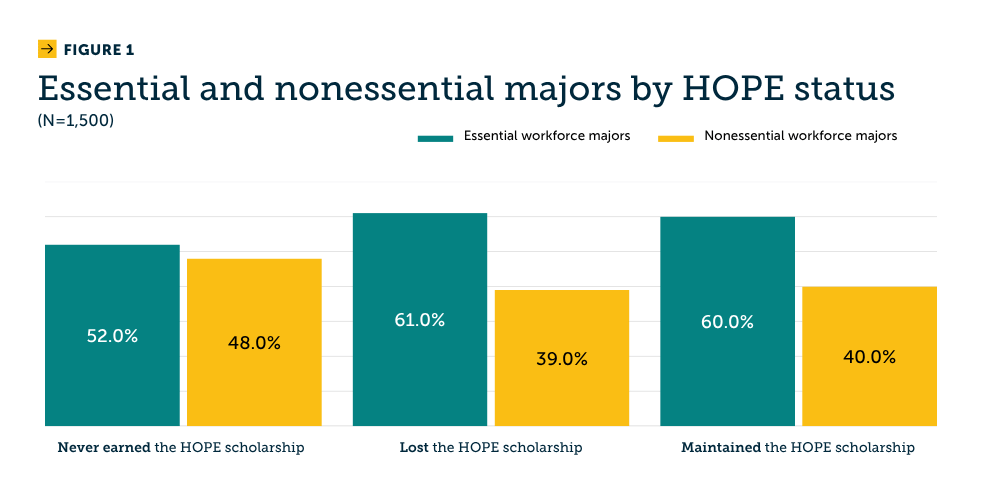
As Figure 1 illustrates, individuals who lost the HOPE scholarship showed the greatest variability in major selection. The differential between numbers of students who selected essential workforce majors and nonessential workforce majors was lowest in individuals who did not earn the HOPE scholarship at just 4%.
To gain greater understanding, it was important to broaden the scope and gain clarity on the specific major selections connected to HOPE status. It is understood that the selection of a major is an important decision because it can have long-term implications for an individual’s future earnings.10
Examining the various major areas connected to graduates’ HOPE status offered several insights. (See Figures 2 and 3.)
First, among essential workforce majors, well over half of nursing and education graduates maintained the HOPE scholarship. (See Figure 2.) Among nonessential workforce majors, just under half of social sciences maintained the HOPE scholarship. (See Figure 3.)
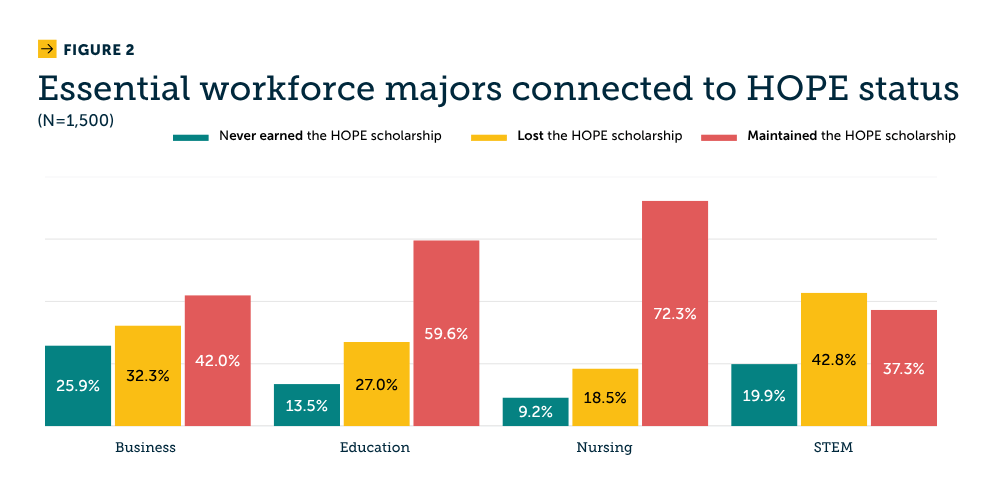
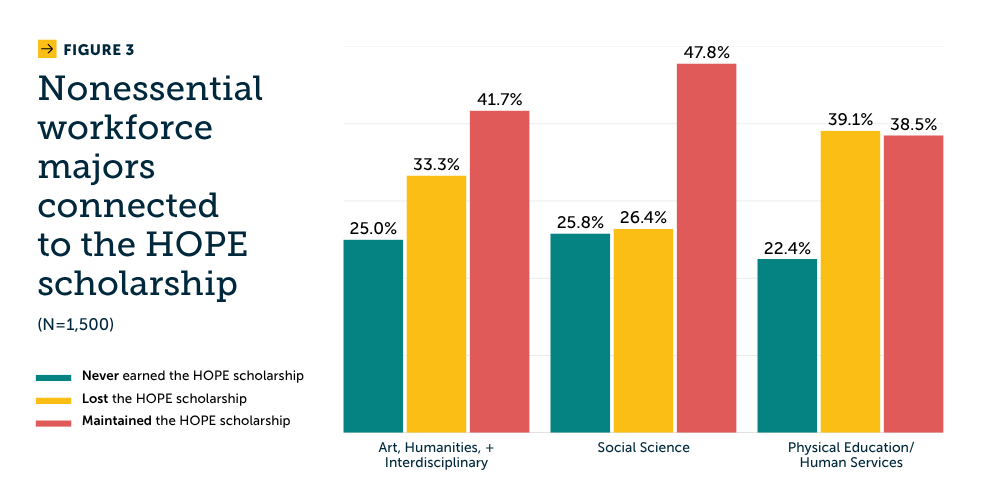
The only major areas where those who maintained the HOPE scholarship were not the majority were in STEM and physical education/human services. This result connected to STEM majors is congruent with previous findings and suggests the need for increased support for individuals seeking degrees in these areas.11,12
Regarding physical education/human services, the results of this study may suggest the need for greater support for these students as well, but what causes these students to lose the HOPE scholarship while earning a degree requires further study.
Implications
A thriving economic community is supported when business, government and education work in tandem. It is not sufficient to just have an educated population. That population must have the appropriate education and support to fuel growth. In Georgia, the HOPE scholarship has shown to be a critical policy for advancing the success of the state. In order for the state to continue to be at the forefront of innovation, we must continue to explore ways to offer educational opportunities and incentivize the needed areas for growth.
This study, among other variables, explored the relationship between HOPE status and student major selection specifically connected to Georgia's workforce needs. Although the study suggests that the HOPE scholarship has expanded opportunities for individuals in Georgia, the scholarship in isolation is not enough. If the state seeks to develop an educated population ready to meet the needs of the state, increased support for all students earning a bachelor’s degree is important.
In addition, we must recognize that while there is a need for citizens with specialized knowledge and skills to lead our state forward, education should never be seen as merely a “ticket to a trade.” Higher education must be much more than that. It needs to be an experience that challenges a person’s perspective, connects them with diverse forms of thought, and inspires them to positively contribute to the advancement of all members of society.
Endnotes
1 Lee, J., & Allen, E. (2020). Moving HOPE forward into the 21st century. Georgia Budget and Policy Institute. Retrieved from https://gbpi.org/wp-content/uploads/2020/09/20200910-MovingHopeForward-v4.pdf.
2 Office of the Lieutenant Governor of Georgia. (2024, February 26). Lt. Governor Burt Jones empowering Georgia’s workforce. Retrieved from https://ltgov.georgia.gov/press-releases/2024-02-26/lt-governor-burt-jones-empowering-georgias-workforce.
3 In 2011, a tiered system for the HOPE scholarship was adopted: the Zell Miller Scholars program for students who earn a 3.70 or above GPA in high school, which covers full tuition, and a general HOPE scholarship, which provides funding at 70% of tuition for those who earn a 3.00 to a 3.69 GPA in high school. For purposes of the study, both groups were considered HOPE scholars.
4 Holden, L., & Biddle, J. (2017). The introduction of human capital theory into education policy
in the United States. History of Political Economy, 49(4), 537–574. https://doi.org/10.1215/00182702-4296305.
5 Blinder, A. S. & Reis, R. (2005, August 25-27). Understanding the Greenspan standard. [Paper
presentation]. Federal Reserve Bank of Kansas City Symposium, Jackson Hole, WY, United States. Retrieved from www.princeton.edu/~ceps/workingpapers/114blinderreis.pdf.
6 Isham, A., Mair, S., & Jackson, T. (2021). Worker wellbeing and productivity in advanced economies: Re-examining the link. Ecological Economics, 184. https://doi.org/10.1016/j.ecolecon.2021.106989.
7 Ibid.
8 Elsdon, R., & Erickson, R. (2010). What does workforce strength look like and why does it matter? In R. Elsdon (Ed.), Building Workforce Strength: Creating Value Through Workforce and Career Development, pp. 3-22. Praeger.
9 Leavitt, M., & Leigh, E. W. (2023). Employer and community college partnerships: Models and
practices for supporting students and strengthening the workforce. Strada Education Foundation. Retrieved from www.strada.org/reports/employer-and-community-college-partnerships-models-and-practices-for-supporting-students-and-strengthening-the-workforce.
10 Bleemer, Z., Davidson, A., & Mehta, A. (2023, July 23). Restricted access to lucrative college majors harms underrepresented students most. Brookings. Retrieved from www.brookings.edu/articles/restricted-access-to-lucrative-college-majors-harms-underrepresented-students-most/.
11 Cornwell, C., Mustard, D. B., & Sridhar, D. J. (2006). The enrollment effects of merit‐ based financial aid: Evidence from Georgia’s HOPE program. Journal of Labor Economics, 24(4), 761–786. https://doi.org/10.1086/506485.
12 Zhang, L. (2011). Does merit-based aid affect degree production in STEM fields?
Evidence from Georgia and Florida. The Journal of Higher Education, 82(4), 389–415. https://doi.org/10.1080/00221546.2011.11777210.