Employer hiring for the Class of 2026 is increasing, but growth is uneven across industries and employer types.
AI is reshaping how work gets done, and expectations for early talent continue to evolve.
Explore the data and insights shaping how employers are recruiting entry-level talent.
Posted April 2026.
Sponsored by


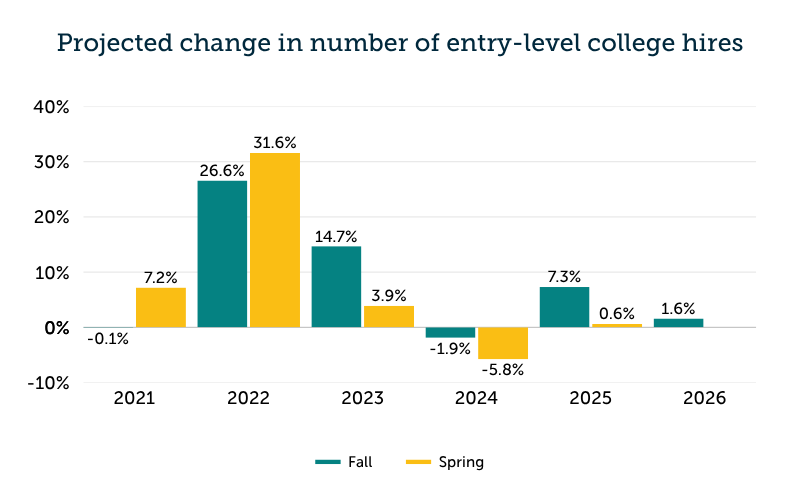
Employers expect to increase new college graduate hiring from the Class of 2026 by 5.6%, a projection driven upward by the more than one-third of respondents reporting plans to bring in additional hires, according to results of NACE’s Job Outlook 2026 Spring Update.
Read more
AI is increasingly becoming an expectation for early career talent, shaping both the job market and entry-level work, according to NACE’s 2026 Job Outlook Spring Update.
Read more
When reviewing the resumes of Class of 2026 candidates for entry-level positions, employers are seeking graduates who provide evidence of polished teamwork, problem-solving, and communication skills, according to results of NACE’s Job Outlook 2026 Spring Update survey.
Read more
Overall, employers say new college graduates are reasonably well prepared for the jobs they will enter after graduation—and more than 20% say they are very well prepared, according to NACE’s Job Outlook 2026 Spring Update.
Read moreThe Job Outlook 2026 Spring Update is the final report on employer hiring projections for Class of 2026 college graduates.
Complete the form to access the findings, including trends in hiring intentions, salary expectations, and the growing role of skills-based evaluation.
The Job Outlook 2026 Spring Update survey was conducted from February 12 – March 17, 2026. Of the 185 total respondents, 142 were NACE employer members, representing 19.9% of eligible member respondents. The Job Outlook 2026 Spring Update survey was also distributed to nonmember companies; this group provided an additional 43 responses. The survey updates hiring projections for the Class of 2026; those projections were collected from NACE employer members from August 7 – September 22, 2025, and were reported in Job Outlook 2026, which was published in November 2025.
By region, 6.5% of respondents are from New England, 16.8% are from the Mideast, 30.8% are from the Great Lakes, 8.6% are from the Plains, 15.1% are from the Southeast, 13.0% are from the Southwest, 3.2% are from the Rocky Mountains, and 5.9% are from the Far West. (For additional information about the respondents, see the slides.)
Data are calculated based on the number of respondents to each specific question. Totals may not equal 100% due to rounding.





 Join/Renew